
Understanding WordPress Hooks: Actions vs. Filters
WordPress hooks are a fundamental concept for anyone looking to extend or customize the functionality of WordPress, whether you’re building themes, plugins, or simply tweaking your website. They provide a way to ‘hook into’ the WordPress core, allowing you to execute your own code at specific points during the execution of WordPress. But understanding the difference between WordPress Actions and Filters Explained is crucial. This guide breaks down the complexities and provides clear examples to get you started.
What are WordPress Hooks?
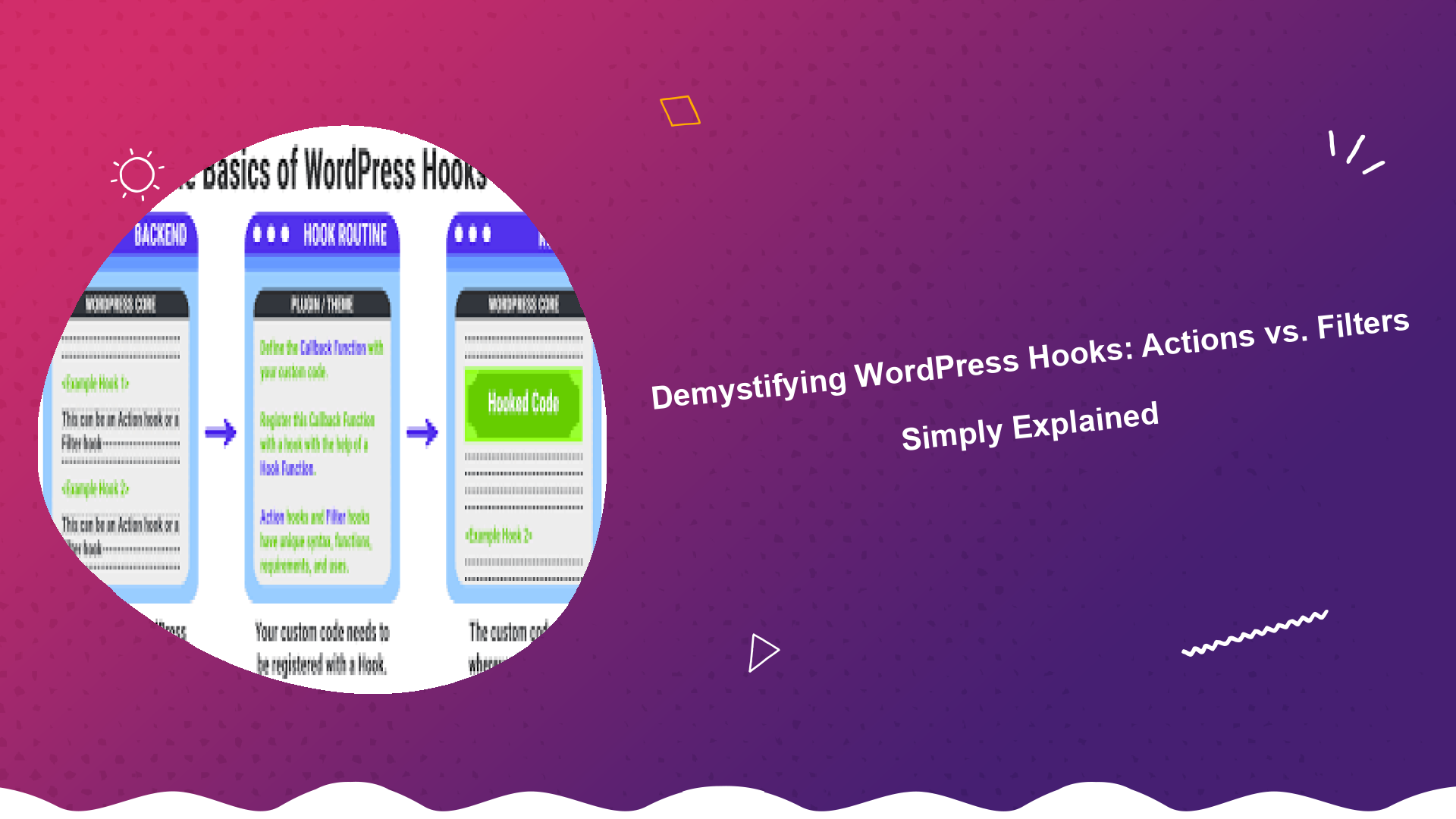
Imagine WordPress as a giant machine with various checkpoints. Hooks are like invitations to participate at these checkpoints. They allow you, as a developer, to insert your code into the WordPress workflow without directly modifying the core files. This is essential for maintaining compatibility and ensuring your customizations survive updates.
There are two primary types of hooks: Actions and Filters. While both serve the purpose of extending WordPress, they operate in fundamentally different ways. Understanding these differences is the key to effective WordPress plugin development.
Actions: Doing Something
Actions are hooks that allow you to execute your code at a specific point in the WordPress execution. They are used to perform tasks, trigger functions, or run processes. Think of them as events that occur, and you can tell WordPress to do something when these events happen.
How Actions Work:
- Actions are triggered by WordPress at specific moments during its execution.
- You use the
add_action()function to attach your custom function to an action hook. - When the action is triggered, your function is executed.
- Actions typically don’t return any values; they simply perform a task.
Example of Using an Action:
function my_custom_action_function() {
echo 'This message is added through an action!
';
}
add_action( 'wp_footer', 'my_custom_action_function' );
In this example, the my_custom_action_function() will be executed when the wp_footer action is triggered, adding a paragraph to the footer of your website. You can learn more about creating plugins by checking out this guide on how to create a simple WordPress plugin.
Common Action Hooks:
wp_head: Runs in the<head>section of the website.wp_footer: Runs at the end of the<body>section.save_post: Runs when a post is saved or updated.admin_notices: Displays admin notices in the WordPress dashboard.
Filters: Modifying Data
Filters, on the other hand, are used to modify data as it passes through WordPress. They allow you to intercept data, change it, and then return the modified data back to WordPress. Think of them as checkpoints where you can transform information.
How Filters Work:
- Filters are triggered when WordPress needs to process or display data.
- You use the
add_filter()function to attach your custom function to a filter hook. - Your function receives the data as an argument, modifies it, and returns the modified data.
- Filters must return a value; otherwise, the data flow will be interrupted.
Example of Using a Filter:
function my_custom_filter_function( $text ) {
  $text = str_replace( 'WordPress', 'Awesome WordPress', $text );
  return $text;
}

add_filter( 'the_content', 'my_custom_filter_function' );
In this example, the my_custom_filter_function() intercepts the content of a post (the_content) and replaces every instance of ‘WordPress’ with ‘Awesome WordPress’. The modified content is then returned to WordPress for display. Optimizing your website’s speed is crucial; this wordpress website speed optimization guide offers some tips.
Common Filter Hooks:
the_content: Filters the content of a post or page.the_title: Filters the title of a post or page.wp_mail_from: Filters the ‘From’ email address for WordPress emails.excerpt_length: Filters the length of the excerpt.
Actions vs. Filters: Key Differences
The table below highlights the key differences between actions and filters:
| Feature | Actions | Filters |
|---|---|---|
| Purpose | To perform tasks or trigger functions. | To modify data. |
| Return Value | No return value is required. | A return value is required (the modified data). |
| Function Signature | add_action( 'hook_name', 'function_name', priority, accepted_args ); |
add_filter( 'hook_name', 'function_name', priority, accepted_args ); |
Practical Examples of Actions and Filters
Let’s look at some more practical examples to solidify your understanding of WordPress Hook Types.
Action Example: Sending a Welcome Email to New Users
function send_welcome_email( $user_id ) {
  $user = get_userdata( $user_id );
  $to = $user->user_email;
  $subject = 'Welcome to Our Website!';
  $message = 'Thank you for registering!';
  wp_mail( $to, $subject, $message );
}

add_action( 'user_register', 'send_welcome_email' );
This code uses the user_register action, which is triggered when a new user registers on your WordPress site. The function send_welcome_email() then sends a welcome email to the new user.
Filter Example: Adding Custom CSS Classes to the Body Tag
function add_custom_body_class( $classes ) {
  if ( is_page( 'contact' ) ) {
    $classes[] = 'contact-page';
  }
  return $classes;
}

add_filter( 'body_class', 'add_custom_body_class' );
This code uses the body_class filter to add a custom CSS class (contact-page) to the <body> tag when the user is viewing the ‘contact’ page. This allows you to apply specific styling to that page. For more information on creating custom WordPress Themes, check out this guide on custom WordPress theme development tutorial.
Best Practices for Using WordPress Hooks
To ensure your code is maintainable and doesn’t conflict with other plugins or themes, follow these best practices:
- Use unique function names: Prefix your function names with a unique identifier (e.g., your plugin or theme name) to avoid naming conflicts.
- Use the correct priority: The
priorityargument inadd_action()andadd_filter()determines the order in which your function is executed. Lower numbers run earlier. - Check for function existence: Before defining your function, check if it already exists using
function_exists()to prevent errors. - Deactivate hooks when necessary: Use
remove_action()andremove_filter()to deactivate hooks when your plugin or theme is deactivated. - Properly escape data: Sanitize data before saving it to the database and escape data before displaying it to prevent security vulnerabilities.
Further Learning and Resources
Understanding WordPress actions and filters Explained is a stepping stone to becoming a proficient WordPress developer. Here are some resources to further your knowledge:
- WordPress Codex: WordPress Hooks
- WPBeginner: WordPress Hooks Visual Guide for Beginners
Conclusion
WordPress hooks are a powerful tool for extending and customizing WordPress. By understanding the difference between actions and filters and following best practices, you can create robust and maintainable themes and plugins. Remember that Actions are about doing something, while Filters are about modifying something. Happy coding! You can also learn about wordpress custom post types tutorial to extend WordPress in additional ways.