
Modernizing Legacy PHP Applications: A Framework-Focused Approach
Legacy PHP applications, while functional, often suffer from technical debt, outdated security protocols, and difficulties in maintenance and scaling. Modernizing these applications is crucial for long-term viability and competitiveness. However, a complete rewrite from scratch can be a costly and time-consuming endeavor. A more pragmatic approach involves strategically adopting a PHP framework to gradually refactor and modernize the existing codebase with minimal code rewrite. This article explores the key considerations when choosing a PHP framework for legacy application modernization, focusing on minimizing disruption and maximizing efficiency.
Understanding the Challenges of Legacy Systems
Before diving into framework selection, it’s essential to acknowledge the common challenges associated with legacy PHP applications:
- Lack of Structure: Many older applications lack a clear architectural pattern, making them difficult to understand and maintain.
- Outdated Code: They may use deprecated PHP features or libraries, posing security risks and compatibility issues.
- Poor Performance: Inefficient database queries and unoptimized code can lead to slow response times.
- Security Vulnerabilities: Older applications often lack modern security practices, making them vulnerable to attacks.
- Limited Scalability: They may not be designed to handle increasing traffic or data volumes.
- High Maintenance Costs: Difficulty in finding developers with expertise in older technologies can drive up maintenance costs.
Addressing these challenges requires a phased approach, starting with a thorough assessment of the existing codebase. This assessment should identify key areas for improvement, potential security vulnerabilities, and opportunities for optimization. This is where the right framework comes into play, providing tools and structure to facilitate the modernization process.
Key Considerations for Choosing a PHP Framework
Selecting the right PHP framework is critical for a successful modernization project. The best php framework for migration will depend heavily on the specific characteristics of your legacy application. Here are several key factors to consider:
- Learning Curve: Choose a framework with a relatively gentle learning curve, especially if your team has limited experience with modern PHP development.
- Community Support: A large and active community provides ample resources, documentation, and support. This can be invaluable when encountering challenges during the migration process.
- Documentation: Comprehensive and well-maintained documentation is essential for understanding the framework’s features and capabilities.
- Integration Capabilities: The framework should offer seamless integration with existing database systems and other technologies used in the legacy application. Consider frameworks offering ORM functionality.
- Security Features: Robust security features, such as built-in protection against common web vulnerabilities, are crucial for protecting the modernized application.
- Scalability: The framework should be designed to handle increasing traffic and data volumes, ensuring the application can scale as needed.
- Extensibility: The framework should allow for easy extension with custom modules or libraries to meet specific application requirements.
- Backward Compatibility: While complete backward compatibility isn’t always possible, look for frameworks that offer some level of compatibility with older PHP versions to ease the transition.
Popular PHP Framework Candidates for Legacy Modernization
Several PHP frameworks are well-suited for modernizing legacy applications. Here’s a brief overview of some popular options, taking into account the need for minimal code change framework choices.
Laravel: The Developer-Friendly Choice
Laravel is a widely popular PHP framework known for its elegant syntax, extensive features, and strong community support. Its powerful ORM (Eloquent) simplifies database interactions, and its template engine (Blade) makes it easy to create dynamic views. Laravel’s Artisan command-line tool provides a range of helpful commands for generating code, running migrations, and managing the application. Its active ecosystem is fantastic. Moreover, consider investigating laravel file upload best practices before implementing file handling if this is part of your project.
However, Laravel’s full-fledged nature can also be a drawback. For smaller legacy apps, the initial learning curve and overhead might be higher than necessary. Also, migrating complex legacy code to Laravel’s MVC structure requires significant refactoring, potentially conflicting with the goal of minimal code rewrite.
Symfony: The Enterprise-Grade Framework
Symfony is a robust and flexible PHP framework that forms the foundation for many other popular frameworks and applications. It’s known for its modular architecture, extensive configuration options, and adherence to best practices. Symfony’s component-based design allows you to use individual components in your existing application without adopting the entire framework. This is where it is strong as an answer to the need for a framework where you’re looking to modernize legacy php application. This can be particularly useful for gradually modernizing legacy code.
Symfony has a steeper learning curve than Laravel, and its configuration-heavy approach can be daunting for beginners. However, its flexibility and scalability make it a good choice for complex legacy applications that require a high degree of customization. Consider if Symfony is right for your case in your efforts to choose the best php framework REST API authentication.
CodeIgniter: The Lightweight Option
CodeIgniter is a lightweight PHP framework known for its simplicity, speed, and ease of use. It’s a good choice for smaller legacy applications that don’t require the full feature set of more complex frameworks like Laravel or Symfony. CodeIgniter’s simple structure and minimal configuration make it relatively easy to learn and integrate into existing codebases, and it is a sensible answer to the need for easiest php framework to migrate legacy application.
However, CodeIgniter lacks some of the advanced features and tools found in other frameworks, such as a built-in ORM and a sophisticated templating engine. It also has a smaller community and less extensive documentation than Laravel or Symfony. While it’s a solid option in the PHP Development world, it might not be suited to every legacy application. Learn more about PHP Development here.
Slim: The Microframework Approach
Slim is a microframework for PHP that focuses on simplicity and minimalism. It provides a minimal set of features, allowing you to build web applications and APIs with maximum flexibility and control. Slim is an excellent choice for modernizing legacy APIs or building new APIs on top of existing legacy code. It offers strong support for routing, middleware, and HTTP request/response handling.
Slim’s minimalist nature can be a double-edged sword. While it provides maximum flexibility, it also requires you to handle many tasks manually that are automated in more full-featured frameworks. It might not be suitable for modernizing complex legacy applications with extensive user interfaces.
A Step-by-Step Approach to Legacy Modernization
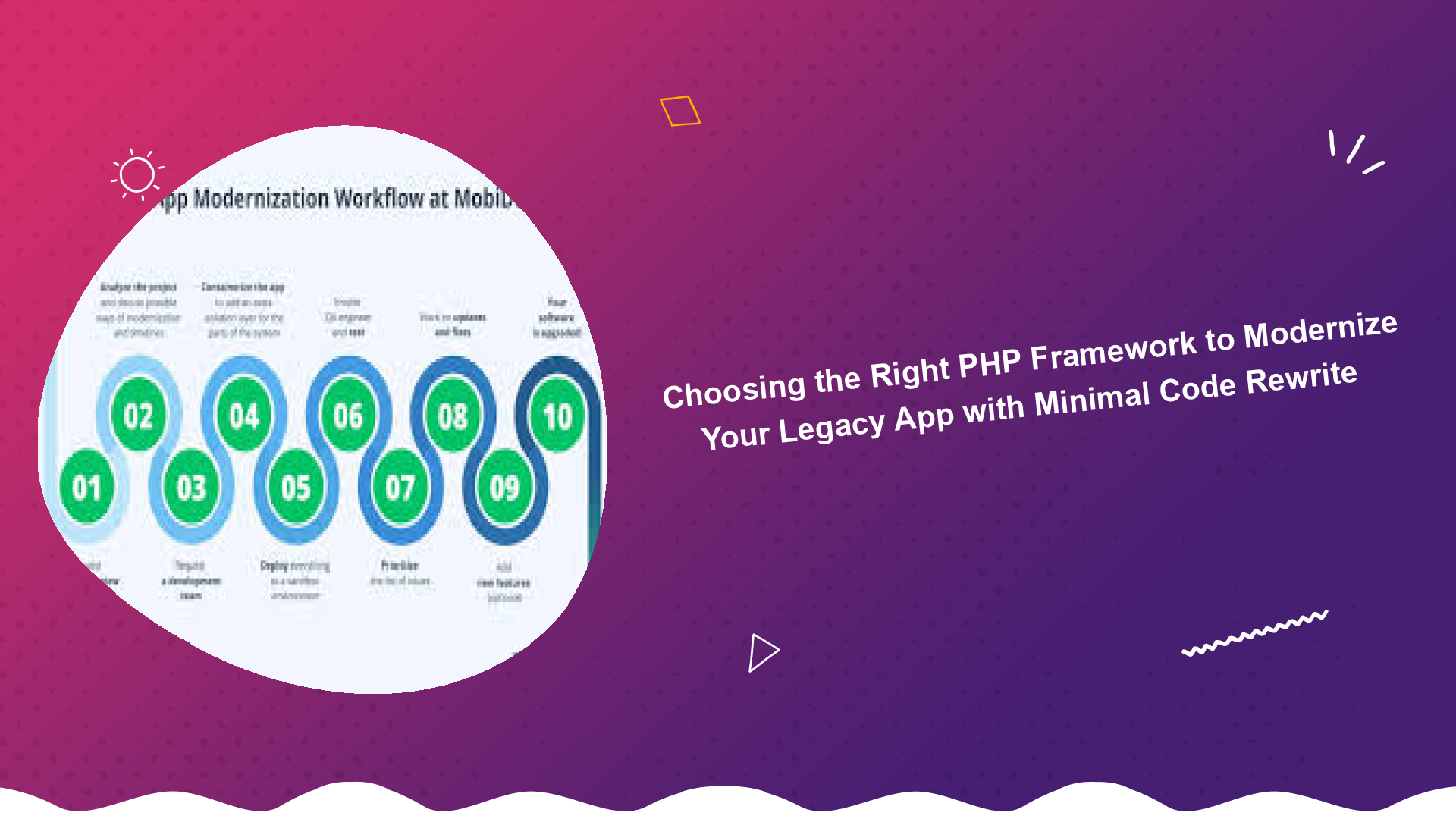
Regardless of the chosen framework, a structured and phased approach is essential for successful legacy application modernization. Here’s a recommended approach:
- Assessment and Planning: Thoroughly analyze the existing codebase to identify key areas for improvement, potential security vulnerabilities, and opportunities for optimization. Define clear goals and objectives for the modernization project.
- Framework Selection: Choose a PHP framework that aligns with the project’s goals, technical requirements, and the team’s expertise. Consider factors such as learning curve, community support, documentation, and integration capabilities.
- Environment Setup: Set up a development environment with the chosen PHP framework and all necessary dependencies. Ensure that the environment is isolated from the production environment to avoid disrupting existing operations.
- Gradual Refactoring: Begin refactoring the legacy code in small, manageable steps. Focus on improving code quality, addressing security vulnerabilities, and optimizing performance. Use the framework’s features and tools to simplify the refactoring process.
- Unit Testing: Write unit tests for each refactored component to ensure that it functions correctly and to prevent regressions. Unit testing is crucial for maintaining code quality and stability throughout the modernization process.
- Integration Testing: Perform integration tests to ensure that the refactored components integrate seamlessly with the existing legacy code. This helps to identify and resolve any compatibility issues.
- Deployment: Deploy the refactored code to a staging environment for testing and validation. Once the code has been thoroughly tested, deploy it to the production environment.
- Monitoring and Maintenance: Monitor the application’s performance and stability after deployment. Address any issues that arise and continue to refactor and optimize the code as needed.
Minimizing Code Rewrite: Strategies and Techniques
The goal of modernizing with minimal code rewrite is achieved through several strategies:
- Facade Pattern: Use the Facade pattern to create a simplified interface to the legacy code. This allows you to interact with the legacy code without directly modifying it.
- Adapter Pattern: Use the Adapter pattern to adapt the legacy code to the framework’s interfaces. This allows you to reuse the legacy code with minimal changes.
- Strangler Fig Pattern: Gradually replace the legacy code with new, framework-based components. This allows you to modernize the application in small, incremental steps without disrupting existing operations.
- Database Abstraction: Use the framework’s ORM or database abstraction layer to access the legacy database. This allows you to decouple the application from the specific database system.
- API Wrappers: Wrap legacy code with APIs, enabling new applications and services to interact with the legacy system without requiring extensive modifications.
Example Scenario: Modernizing a Legacy PHP Application with Laravel
Let’s consider a scenario where you need to modernize a legacy PHP application that manages customer data. The application currently uses a procedural coding style and lacks proper security measures.
Here’s how you might approach the modernization using Laravel:
- Assessment: Identify the key modules and components of the application, such as customer management, order processing, and reporting. Assess the code quality, security vulnerabilities, and performance bottlenecks.
- Framework Setup: Install Laravel and configure it to connect to the legacy database.
- Database Abstraction: Create Eloquent models to represent the customer data and other entities in the database.
- Routing: Define routes for the application’s different functionalities, such as displaying customer information, creating new customers, and updating existing customers.
- Controllers: Create controllers to handle the requests and interact with the Eloquent models.
- Views: Create Blade templates to display the customer data in a user-friendly format.
- Security: Implement security measures, such as authentication and authorization, to protect the application from unauthorized access.
- Gradual Refactoring: Start refactoring the legacy code in small, manageable steps. Focus on improving code quality, addressing security vulnerabilities, and optimizing performance.
For example, you might start by creating a new Laravel controller to handle customer creation. The controller would receive the customer data from the user interface, validate the data, and then use the Eloquent model to save the data to the database. The legacy code that handles customer creation would be gradually phased out and replaced with the new Laravel controller.
// Legacy PHP Code
function createCustomer($name, $email) {
  // Database connection code
  $query = "INSERT INTO customers (name, email) VALUES ('$name', '$email')";
  // Execute the query
}

// Laravel Controller
namespace AppHttpControllers;

use AppModelsCustomer;
use IlluminateHttpRequest;

class CustomerController extends Controller
{
    public function store(Request $request)
    {
        $validatedData = $request->validate([
            'name' => 'required|max:255',
            'email' => 'required|email|unique:customers',
        ]);

        $customer = new Customer();
        $customer->name = $validatedData['name'];
        $customer->email = $validatedData['email'];
        $customer->save();

        return redirect('/customers')->with('success', 'Customer created successfully!');
    }
}
This example demonstrates how you can gradually replace the legacy code with new, framework-based components. By using a phased approach and focusing on minimal code rewrite, you can successfully modernize your legacy PHP application without disrupting existing operations.
The Importance of Testing
Thorough testing is paramount during the modernization process. Unit tests, integration tests, and user acceptance tests are all crucial for ensuring the stability and functionality of the application. Embrace test-driven development (TDD) to ensure that new code is well-tested from the outset.
Don’t forget comprehensive easy PHP debugging techniques for beginners to quickly identify and fix issues. Understanding how to find these issues and fix them makes testing far more efficient and productive.
Long-Term Benefits of Modernization
While the initial investment in modernization may seem daunting, the long-term benefits are significant:
- Improved Security: Modern frameworks provide built-in security features to protect against common web vulnerabilities.
- Enhanced Performance: Optimized code and efficient database queries can significantly improve application performance.
- Increased Scalability: Modern frameworks are designed to handle increasing traffic and data volumes.
- Reduced Maintenance Costs: Well-structured code and modern technologies make it easier to maintain and update the application.
- Improved Developer Productivity: Modern frameworks provide a range of tools and features that can significantly improve developer productivity.
- Attract and Retain Talent: Modernizing the technology stack makes the organization more attractive to talented developers.
Conclusion: Strategic Modernization with PHP Frameworks
Modernizing legacy PHP applications is a critical undertaking for organizations seeking to maintain a competitive edge. By carefully choosing the right PHP framework and adopting a phased, strategic approach, you can effectively modernize your applications while minimizing disruption and maximizing the return on investment. Remember to prioritize security, scalability, and maintainability throughout the modernization process. By embracing modern development practices and leveraging the power of PHP frameworks, you can transform your legacy applications into valuable assets for your business.
Consider factors like the experience level of the team as you make your selection. If your team is well versed in JavaScript frameworks, it might be worth exploring options for Laravel Vue.js React integration guide.
Remember to stay up to date on the latest trends and best practices in PHP development to ensure the long-term success of your modernization efforts. For further reading on PHP and associated topics, visit the official PHP documentation and OWASP (Open Web Application Security Project) for secure coding standards.